WE ARE FOOTBALL 2027: Match Engine Tactics Guide (Sliders & Instructions)
Set up tactics in WE ARE FOOTBALL 2027 as the engine reads them: rule-based lineups, philosophy sliders like Gegenpressing, match instructions and set-piece takers.
Frequently Asked Questions
How do the Gegenpressing and pressing sliders work in WE ARE FOOTBALL 2027?
Can the assistant coach build the lineup without ignoring my formation?
What do the score-based match instructions do?
Set the Game Philosophy Before Touching Any Slider
Every tactic in WE ARE FOOTBALL 2027 starts on the General Tactics screen with a game philosophy picked from a carousel — the arrows cycle through presets, and the tutorial settles on attacking football with short passes. The preset description spells out the deal: quick passes forward, finishes first, combination players and fast strikers in demand, build-up losses avoided.
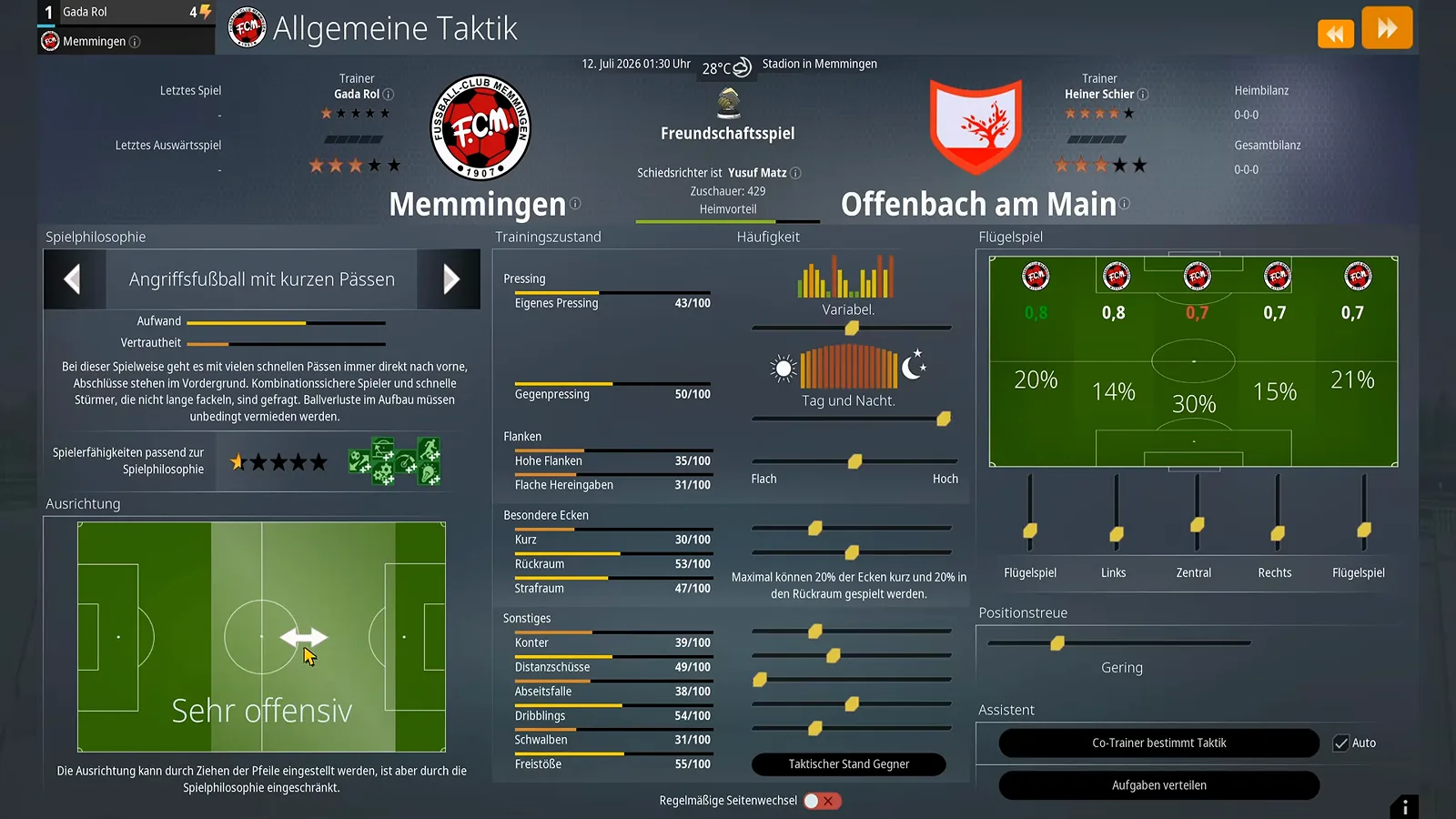
Each preset shows two bars — effort and familiarity — plus a star rating for how well your current squad’s skills match the style. The tutorial’s roster scores one out of five stars, proof that a philosophy is only as good as the players who fit it. The alignment arrow below can be dragged along the defensive-to-offensive gradient, but the caption states plainly that the philosophy limits how far it travels; in the tutorial it rests at very offensive.
The Numeric Sliders the Engine Actually Reads
Below the philosophy sit more than a dozen sliders, each running from 0 to 100. The tutorial’s friendly against Offenbach shows typical mid-range values: own pressing 43/100 and Gegenpressing 50/100, high crosses 35 and cutbacks 31, counters 39, long shots 49, the offside trap 38, dribbling 54 and diving 31. Corners split their deliveries between short routines, the edge of the box and the penalty area, capped at 20% short and 20% back-post. A separate panel splits attacking outlets across both flanks, the half-spaces and central play, and positional discipline gets its own slider — low in the tutorial.
Build the Lineup on the Pitch, Not in a Vacuum
The lineup screen renders every formation as draggable tokens on the grass, each carrying the player’s current rating. The preset basic order is a 5-3-2 line and the assistant would rather play a 4-1-4-1, but the manager wants two strikers, tests a back four and settles on a 4-4-2 diamond with the anchor midfielder — his 4.5-rated defensive midfielder — at its base.
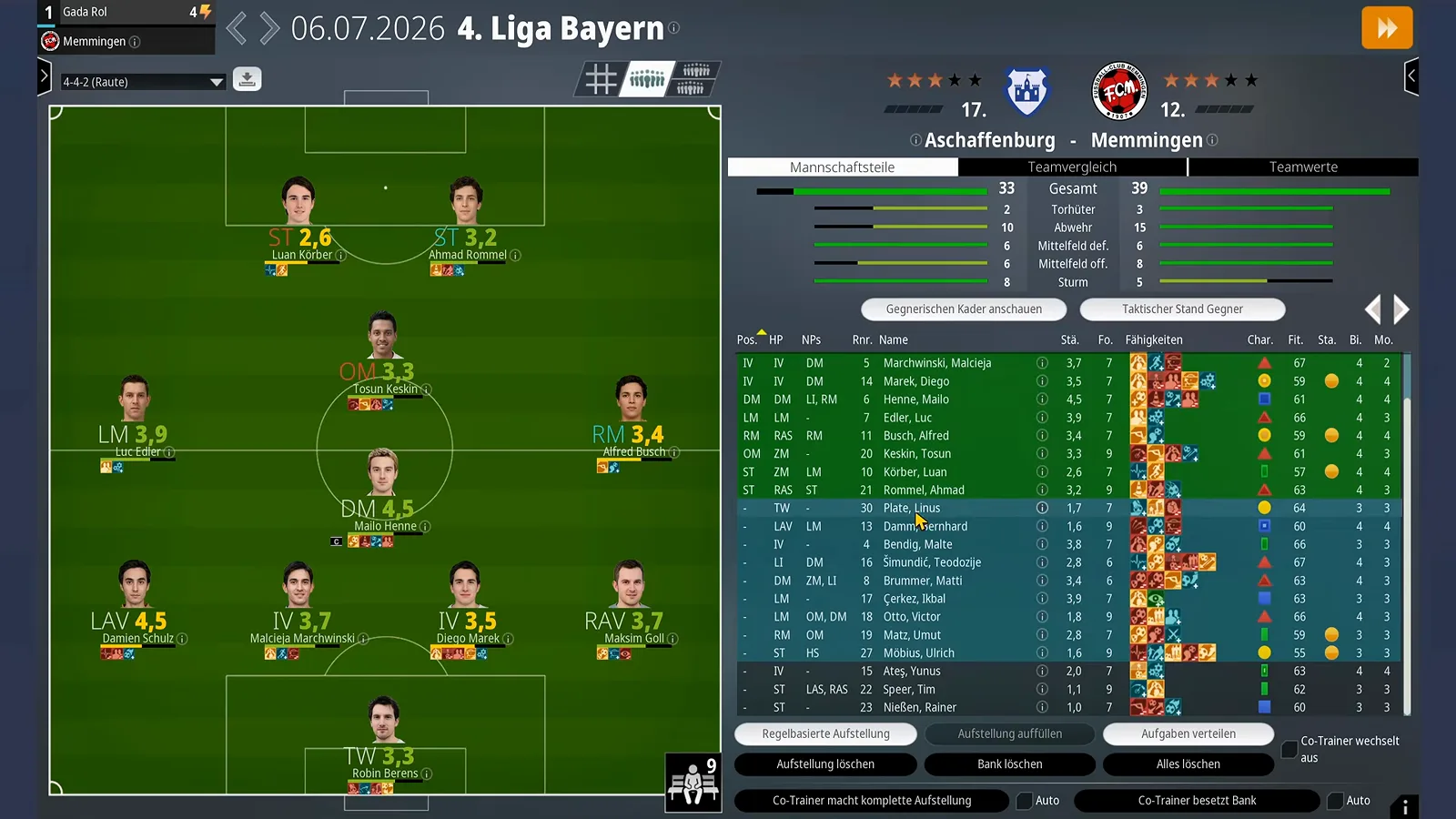
The right panel compares your eleven with the opponent by unit: 33 to 39 overall, 10 to 15 in defence, 8 to 5 up front — an honest underdog picture that should shape expectations before kickoff.
Check squad depth against the formation
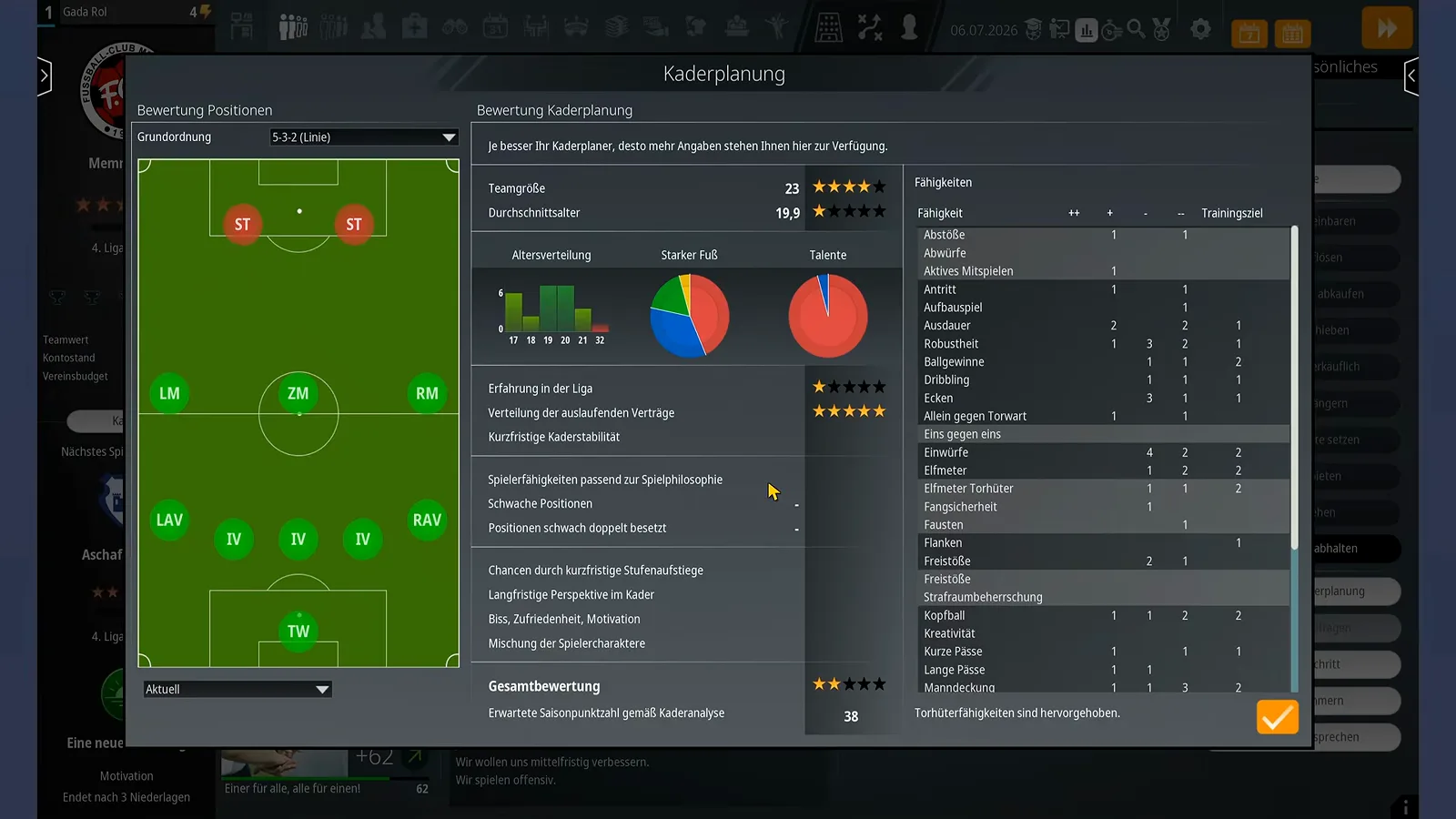
The squad planning overlay rates the whole roster against your basic order: the tutorial’s 23-man squad, average age 19.9, scores 38 — and a better squad planner unlocks more of this data.
Delegate Lineups Without Losing Control
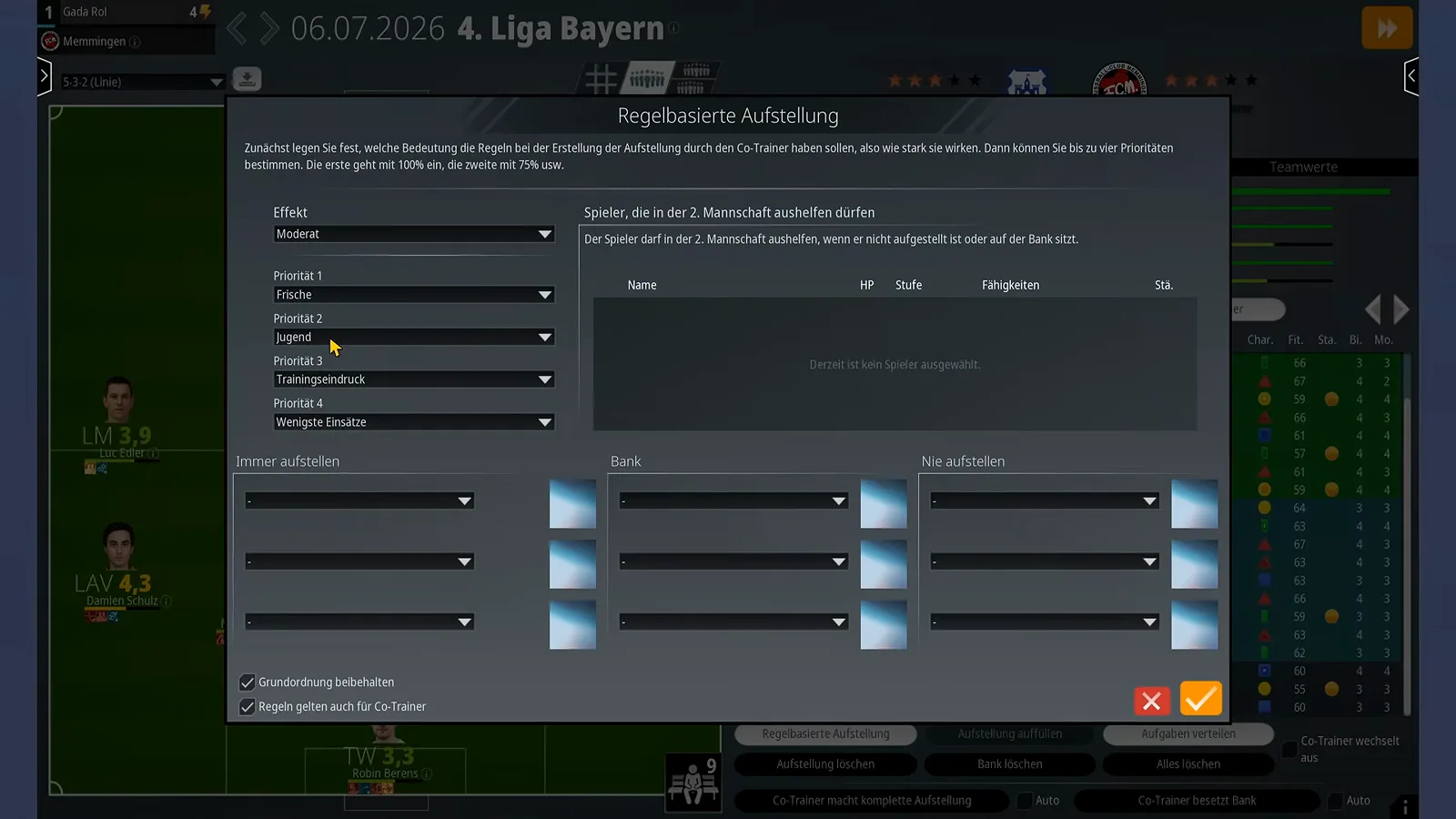
The rule-based lineup dialog automates selection without surrendering it. You set the effect strength (moderate in the tutorial), then up to four priorities weighted 100% and 75% for the first two: freshness, youth, training impression and fewest appearances. Three columns pin must-start, bench and never-play players, while two checkboxes keep your formation and extend the rules to the co-trainer’s changes.
Match Instructions: Effort, Cards and Late-Game Triggers
The match instructions screen decides how the engine plays the game itself. The effort slider carries an explicit warning — high commitment burns freshness and provokes cards — and stays restrained in the tutorial so nobody gets injured in a friendly. The league-only option to ease off at a three-goal lead is greyed out here; full-commitment triggers for when you are level or behind both sit at minute 80. The fouls slider is dragged toward fair play: no yellow cards wanted. Team talks are rationed to once per half-season per player, and up to four rehearsed attacks can be switched on with their training progress shown.
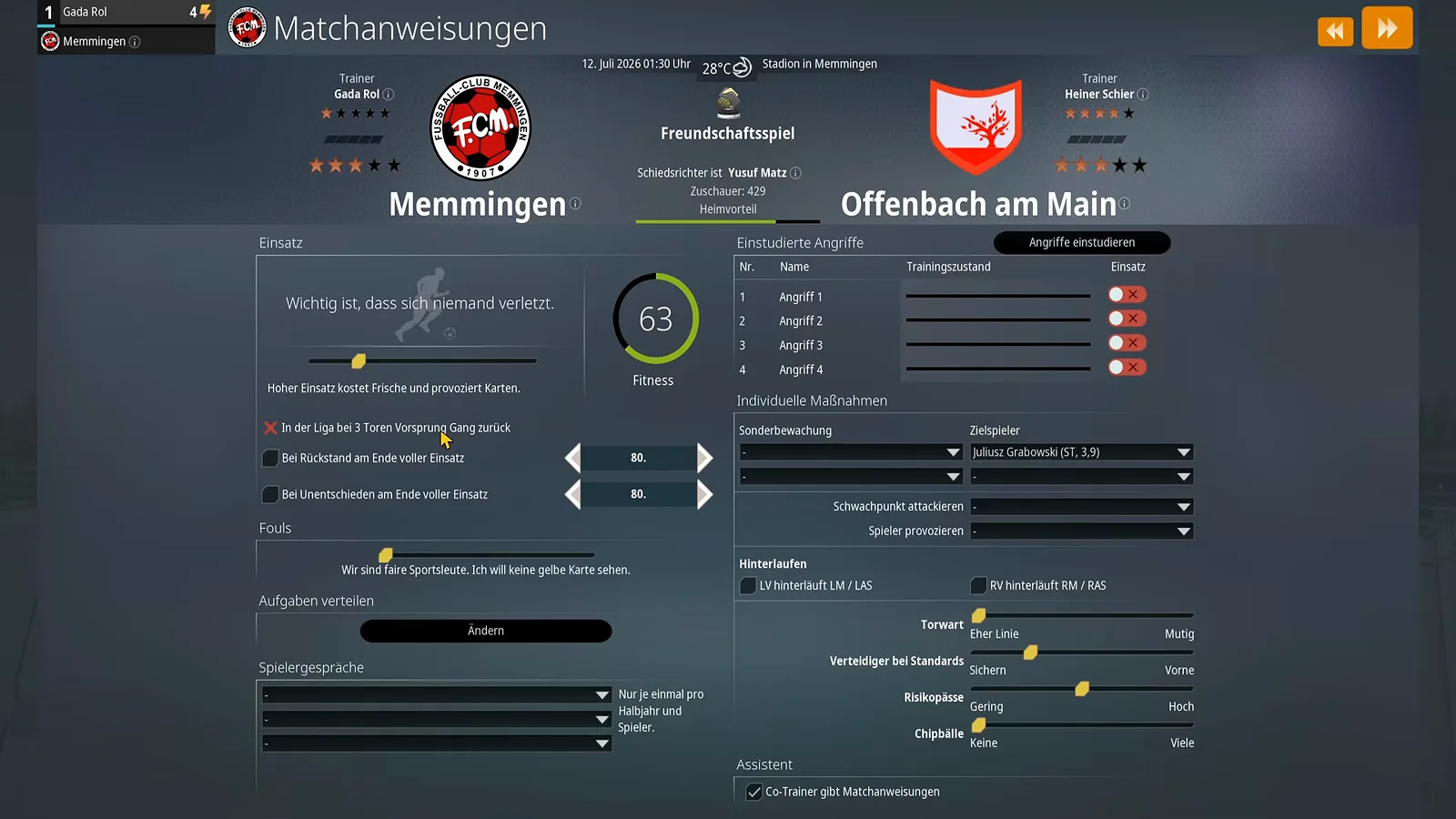
The same screen holds individual measures — a special-marking target (the tutorial flags the opposing striker), exploit-weakness and provoke options, overlapping full-back checkboxes, plus risk sliders for the keeper, defenders at set pieces, risky passes and chips.
Assign Set-Piece Takers Before Kickoff
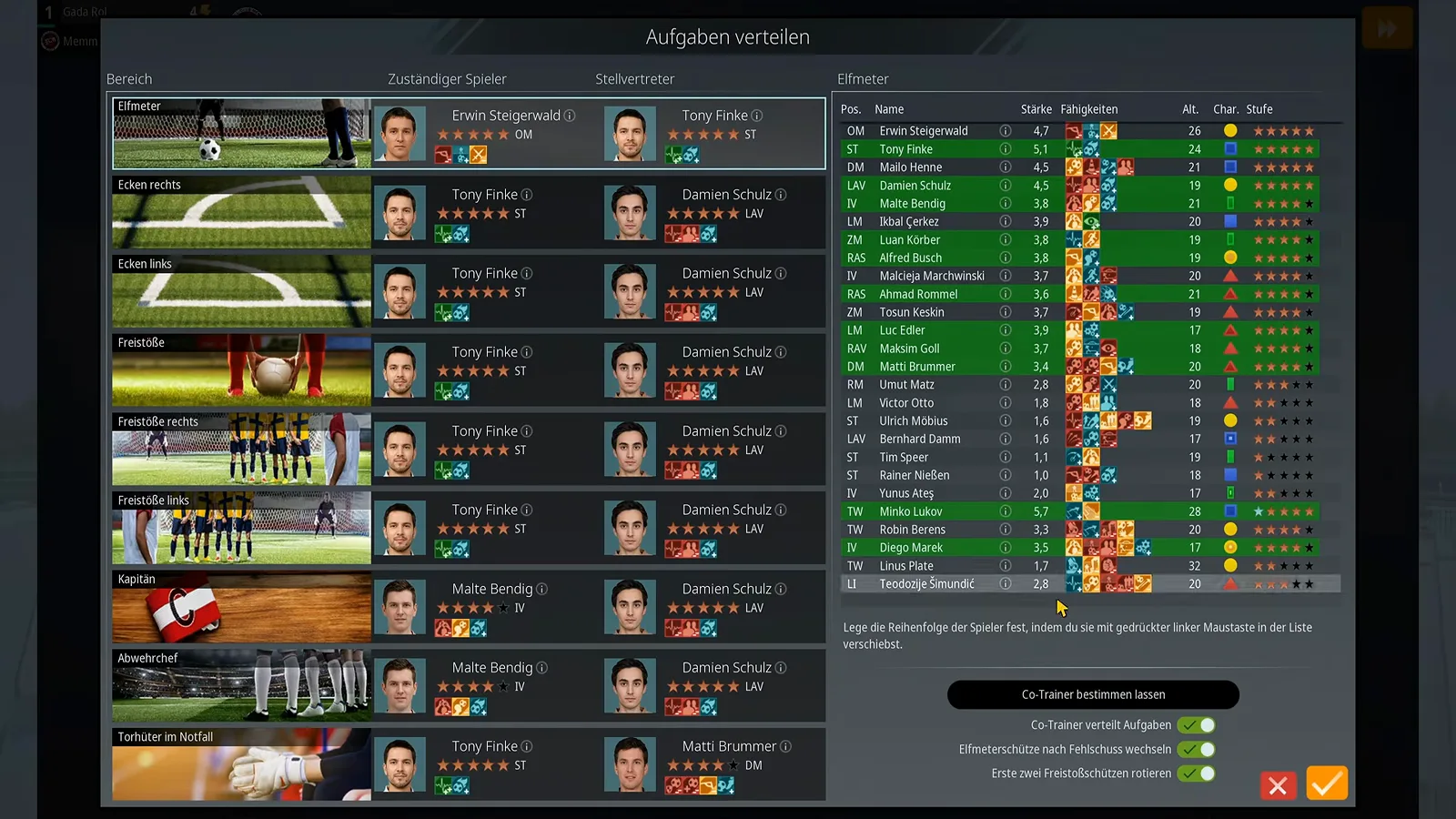
The task assignment window lists every dead-ball duty with a starter and a deputy: penalty, both corner sides, both free-kick flanks, captain, defensive leader and even an emergency goalkeeper. A drag list ranks penalty takers, and toggles let the co-trainer take over, swap the taker after a miss, or rotate the first two free-kick takers.
Read the 3D Engine Like a Coach
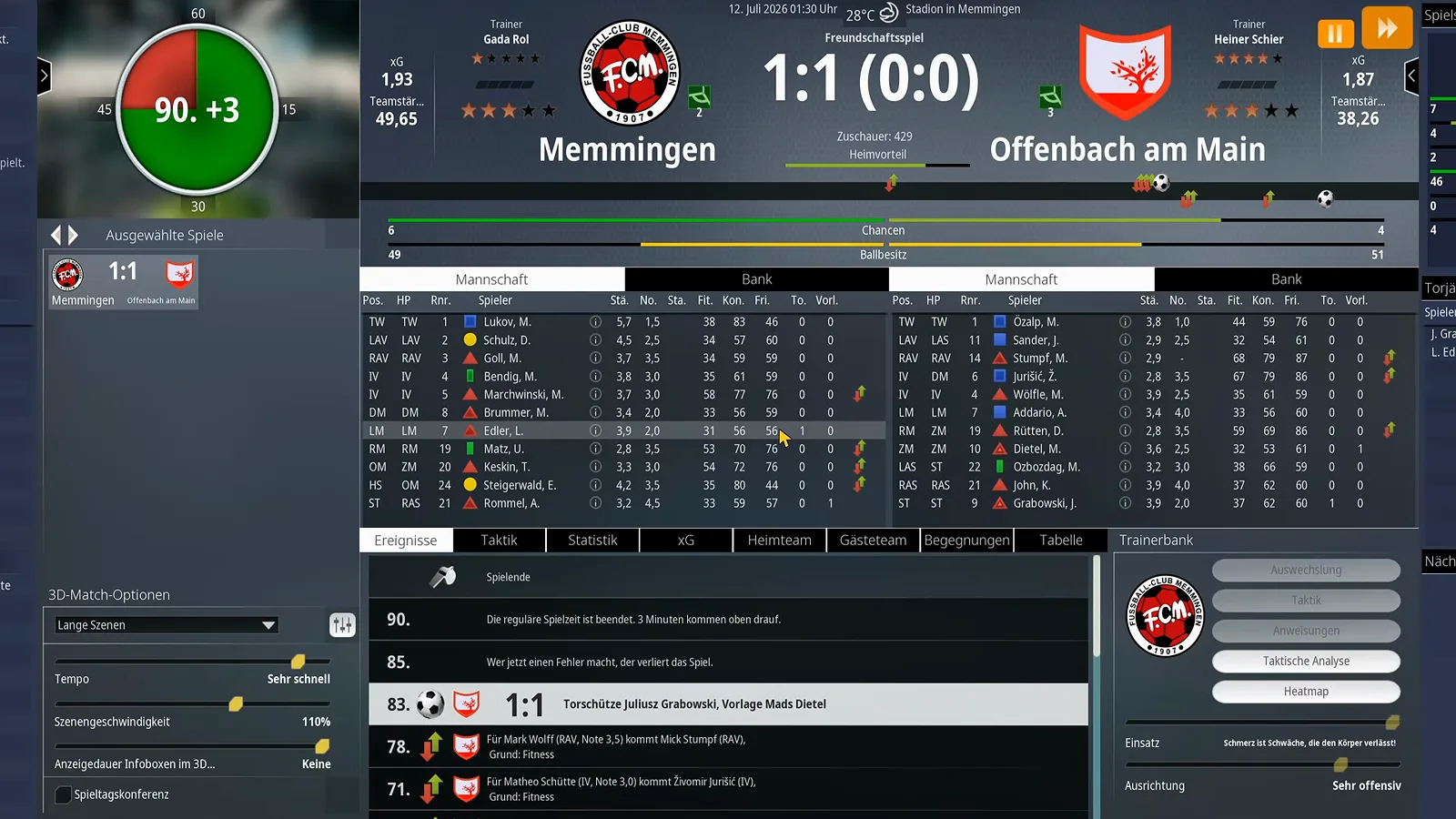
Once the ball rolls, the wide camera shows shape and spacing better than any 2D map, and the scoreboard carries the halftime score in brackets throughout. Every goal triggers a banner with scorer, assist and xG — and the tutorial delivers a cautionary tale: the striker listed as the special-marking target on the Match Instructions screen, Juliusz Grabowski, scores the 83rd-minute equaliser with an xG of 0.58 (assist Mads Dietel). The friendly ends 1:1.
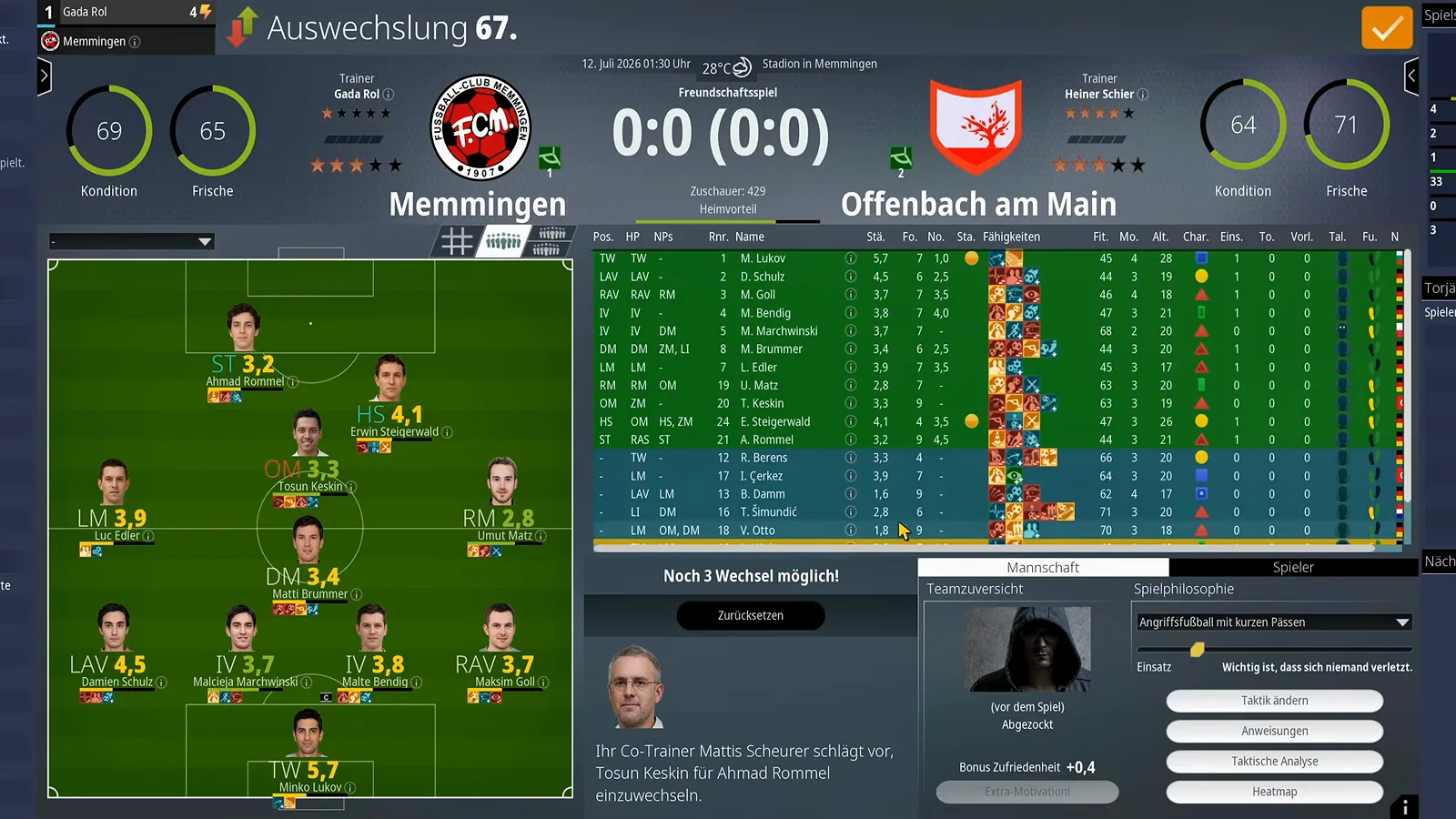
When legs tire, the substitution dialog opens straight over the pitch: condition and freshness gauges for both clubs, a ready co-trainer proposal — Keskin for Rommel in the tutorial — and the count of changes that remain beside tempo and scene-speed controls.
The full-time screen is a coaching debrief in itself: xG 1.93 to 1.87, possession 49 to 51, chances 6 to 4, and an event log where both late substitutions cite fitness.
For the formation meta — the setups the community rates highest this patch — pair this walkthrough with our /tactics/best-tactics-formations/ guide. Squad too thin for your chosen system? Fix it in the /guides/transfer-market-guide/, and set your weekly routine with the /guides/beginner-guide/.
Related Guides
Was this helpful?
Thanks for the feedback!